
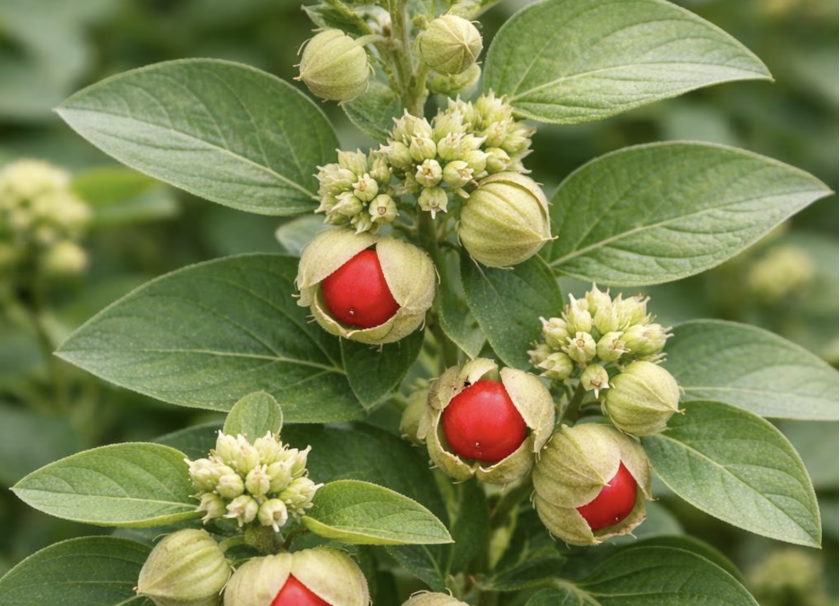
Why Ashwagandha Keeps Coming Up In Conversations About Stress, Strength, and Resilience
As I’ve been revisiting old nutrition textbooks and research from my graduate work in Applied Clinical Nutrition, one thing has become very clear to me. We are living in a state of chronic acceleration.
People are tired, but overstimulated. Wired, but depleted. Strong in some places and completely dysregulated in others.
Honestly, I see versions of this every day in the studio.
Tight necks. Shallow breathing. Difficulty focusing. Trouble recovering. Nervous systems that no longer seem to know the difference between stress and normal life.
Which is part of why I’ve found myself revisiting conversations around adaptogens, particularly Ashwagandha.
Ashwagandha is an herb traditionally used in Ayurvedic medicine and often associated with stress resilience, recovery, sleep support, and nervous system regulation. Unlike stimulants that tend to push the system harder, adaptogens are generally thought to help the body adapt to stress more efficiently.
That idea feels very aligned with Pilates to me.
Because the Pilates system, when practiced well, is not about depletion. It is not about annihilating the body into submission. It is about creating capacity.
Capacity to breathe better. Recover better. Move better. Handle stress better.
The older I get, the more I think real health may depend less on intensity and more on adaptability.
That’s where Ashwagandha becomes interesting.
Traditionally, the Root is the most commonly used part of the plant and the source of most modern supplements and powders. It tends to be associated with stress modulation and recovery support. The Leaves exist in traditional preparations as well, though they are less commonly used in mainstream wellness products and can behave differently biologically.
Same plant. Different application.
Very Pilates.
One apparatus may challenge stability while another builds mobility. One exercise may energize the system while another downregulates it. The method adapts based on what the body needs.
Herbal medicine often works similarly.
I first started paying closer attention to Ashwagandha during periods where my schedule felt relentless. Long teaching days. Travel. Decision fatigue. That feeling where your body is exhausted but your brain refuses to power down.
What interested me was not the promise of “calm.” Honestly, I distrust wellness language that sounds too absolute.
What I appreciated was the possibility of feeling more steady.
More buffered.
Less reactive.
Subtle, but meaningful.
As both a Pilates teacher and physical therapist, I think we dramatically underestimate how much chronic stress shapes the physical body. Stress changes breathing patterns. Muscle tone. Recovery. Sleep quality. Pain perception. Coordination. Even posture.
You can often see it the moment someone walks into the room.
And this is where I think movement and recovery practices belong in the same conversation. The Pilates studio itself can become a form of nervous system training.
The rhythm of springs. Repetitive movement. Breath patterns. Focus. Precision.
The body starts to organize itself differently.
Not because we forced it, but because we created an environment where it could regulate.
That does not mean Ashwagandha is appropriate for everyone, and it certainly does not mean supplements replace fundamentals like movement, sleep, nutrition, or medical care.
But I do think there is something valuable about remembering what I’ve started thinking of as original medicine.
Not optimization.
Not endless stimulation.
Not another productivity tool disguised as wellness.
Just consistent practices that support the body’s ability to adapt.
Movement. Breath. Plants. Rhythm. Recovery.
Simple things that humans have relied on for a very long time.
One Simple Way I Use It
I tend to prefer Ashwagandha in simpler forms rather than highly engineered blends.
Some people use:
Powder Mixed Into Warm Milk Or Tea
Capsules From Reputable Supplement Companies
Evening Tonics With Cinnamon Or Ginger
Personally, I lean toward evening use rather than daytime use, especially during periods of high stress or travel.
Where To Find It
I generally recommend looking for:
Reputable Third-Party Tested Brands
Straightforward Ingredient Lists
Transparent Sourcing
Thorne, which we already recommend in the studio, offers Ashwagandha formulations, and companies like Organic India also produce traditional preparations and teas.
When Ashwagandha May Not Be Appropriate
Ashwagandha is biologically active and should not be treated casually simply because it is “natural.”
Individuals should speak with a qualified healthcare provider before using it regularly, especially if they:
Are Pregnant Or Breastfeeding
Have Autoimmune Conditions
Have Hyperthyroidism Or Thyroid Disorders
Take Sedatives Or Anti-Anxiety Medications
Take Blood Pressure Or Blood Sugar Medications
Have Upcoming Surgery
Have Hormone-Sensitive Conditions
As always, this is educational information, not medical advice, and individualized guidance matters.
The more years I spend inside both movement and nutrition, the more convinced I become that the body responds best to thoughtful systems rather than extremes.
Pilates has always understood that.
Different apparatus. Different strategies. Same philosophy.
Build resilience. Reduce unnecessary stress. Support the body as a whole.